What does Dabba Trading mean? Full Guide
Introduction
In India, the word "dabba trading" is frequently used to refer to an illicit and unauthorized type of trading that occurs outside of stock exchanges that are subject to regulations. Dabba trading uses secret networks run by regional brokers, in contrast to legal trading, where orders are carried out on authorized exchanges.
Trades are not made in the actual market under this arrangement. Rather, they are entered into a broker-maintained proprietary ledger or program. Because of this lack of oversight and transparency, dealers operate in a high-risk environment.
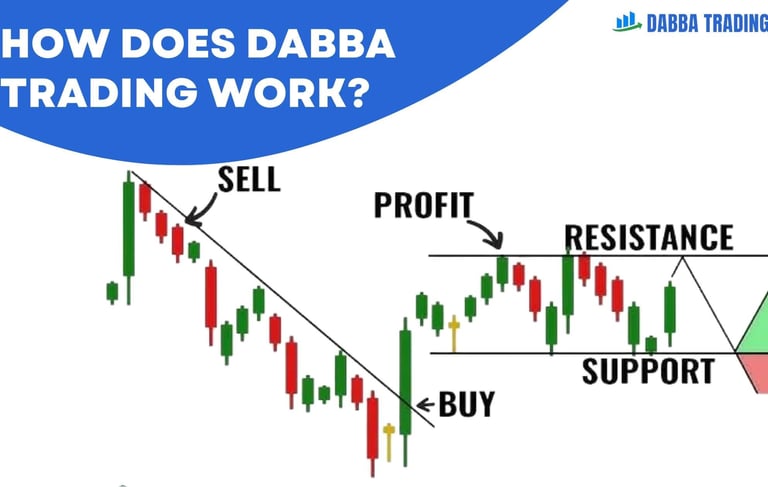
How Dabba Trading Works
When engaging in dabba trading, a trader usually makes contact with a local broker or agent who grants them access to an ID or trading account. This account is not linked to any official exchange, despite the fact that it may appear to be a legitimate trading platform. The broker records the trader's order in their own system rather than sending it to the actual market. The trader and the broker then directly pay all gains and losses. This makes the entire process extremely unreliable and reliant on the broker because the trader is entering into a private agreement based on price changes rather than truly investing in the market.
An Illustration of Dabba Trading
Think about a scenario where a trader chooses to purchase a stock at a specific price in order to have a better understanding of dabba trading. In a legitimate trading arrangement, the trader would own the shares and the order would be executed on an exchange. But in dabba trading, the broker just keeps an internal record of the transaction. The broker gives the trader the profit if the stock price rises. The trader reimburses the broker for the loss if the price drops. This demonstrates that the deal is merely a financial agreement between the trader and the broker, akin to a wager rather than a real investment, and does not exist in the actual market.
Legal Status in India
Because it goes against the rules established by the Securities and Exchange Board of India, which is in charge of overseeing and controlling financial markets, dabba trading is legally prohibited in India. Trading is only allowed on approved exchanges like the Bombay Stock Exchange and the National Stock Exchange. Any transaction conducted outside of authorized exchanges is illegal and may have major legal repercussions for both traders and brokers.
Risks of Dabba Trading
Because all data are under the broker's control and cannot be independently verified, one of the main hazards associated with dabba trading is its lack of transparency. Because of this, there is a greater chance that brokers will manipulate prices, show fictitious profits, or refuse withdrawals. Furthermore, traders have no legal protection, which makes it very difficult to recover money in the event that a broker cheats or vanishes. Dabba trading is a very risky alternative for anyone wishing to invest because there is no regulatory control, which also raises the possibility of financial loss and unscrupulous tactics.


Why People Still Use Dabba Trading
A portion of traders continue to engage in dabba trading despite it being prohibited and extremely dangerous because of convenience, the belief that profits can be made quickly, and ignorance. Easy access is one of the main causes. Dabba trading frequently enables users to begin with few formalities, in contrast to regulated trading platforms that demand appropriate KYC verification, documentation, and bank linkage. It is attractive because of its simplicity, particularly for novices who wish to avoid drawn-out procedures.
The availability of high leverage is another important aspect. A lot of dabba operators let traders to use small amounts of capital to take big positions. Because even slight price changes can result in substantial returns, this gives the impression of increased profit possibilities.
Another compelling feature is the assurance of speedy settlements and withdrawals. Depending on the broker and banking procedure, withdrawals may take some time, while settlements in markets follow a defined cycle. Brokers in dabba trading frequently assert that they provide quicker payouts, which attracts customers seeking instant liquidity. Despite the lack of a payment guarantee, this quickness may provide the impression of reliability.
The false belief that dabba trading aids in avoiding taxes and regulations is another reason why people participate in it. Some traders think they may avoid paying taxes since transactions are not documented in government systems. But this is against the law, and if caught, there might be severe legal repercussions. The short-term advantages of noncompliance frequently outweigh the long-term dangers.
Furthermore, a lot of users are impacted by local networks and word-of-mouth. In certain places, personal connections, agents, or community recommendations are used to encourage dabba trading, which fosters trust. Without fully understanding the risks, new users frequently depend on these tips because they assume it must be safe since others are doing it.
There is a psychological component as well. Dabba trading's gambling-like atmosphere, where gains and losses are immediately apparent, can lead to addiction and exhilaration. Even though the system itself is faulty, traders can be attracted to the fast-paced atmosphere and the potential for rapid money.


Esther Bryce
Founder / Interior designer


Lianne Wilson
Broker


Jaden Smith
Architect


Jessica Kim
Photographer
Educational Disclaimer & Purpose
Important Note: This platform is strictly dedicated to financial literacy and educational awareness. We do not support, condone, or promote any unauthorized or unregulated trading activities.
Our goal is to provide comprehensive market knowledge. Through our interactive paper trading tools, you can safely learn how different market mechanisms work, practice risk management strategies, and gain valuable insights—completely risk-free and in full compliance with standard financial regulations.
ALL RIGHTS RESERVED @dABBATRAders Since 2023